This week, a Japanese Shinto garden took root in southwestern Virginia because of family connections spanning geography and generations. Also, in Whitesburg, Kentucky, a new mosaic uses recovered objects to honor the town’s people after the flood of 2022. And, the young adult novel Verity Vox and the Curse of Foxfire mixes historical fact with spooky Appalachian folklore.
Morgantown-Based Outdoor School Uses Nature To Teach Students To Thrive
Listen
Share this Article
A group of fourth and fifth grade students at Morgantown Learning Academy — a private, non-profit elementary school located in Monongalia County — are sitting at two picnic benches surrounded by a forested canopy on a recent Thursday. This isn’t a special field trip. Every Thursday, students spend part of their classroom time outside with Mountain Stewardship & Outdoor Leadership, or Mountain SOL.
Two streams — Lemon Creek and West Run — meander nearby the outdoor classroom. After a lesson on the basics, the students split into small groups, grab plastic probes the size of TV remotes and hop down into the creeks to take measurements.
“I think there’s a difference in opening up a science textbook and learning about water quality and looking at maps of a watershed,” Hannah Spencer said. Spencer is an instructor with and co-founder of Mountain SOL, an outdoor education program based in Morgantown.
“When you can go outside and be in your own watershed … I think it really brings it down to, to the level of ‘Hey, I have an impact here. And, you know, this is part of my responsibility, and I need to take care of it,’” she said.
Credit Jesse Wright / WVPB
/
WVPB
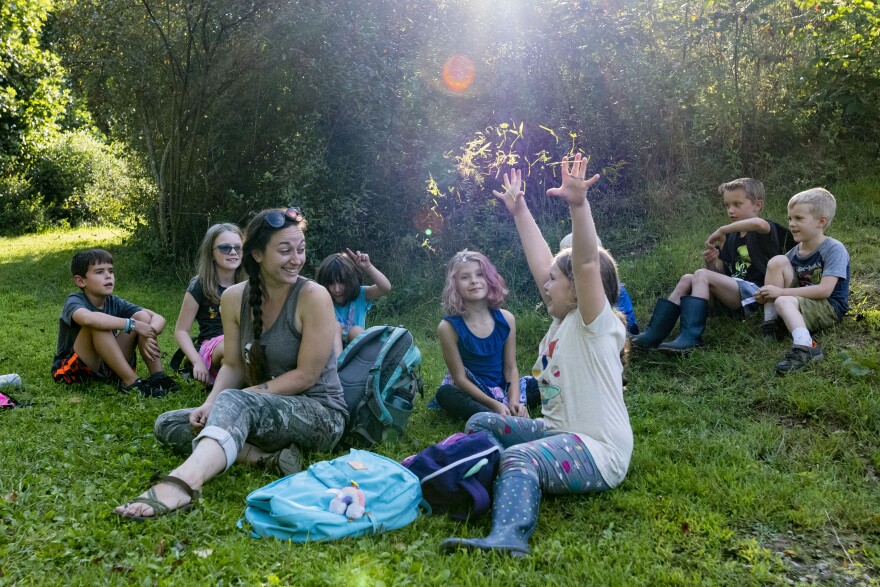
Hannah Spencer, co-founder and instructor at Mountain SOL, sits with some of her students Sept. 13, 2019, at Morgantown Learning Academy in Morgantown, W.Va.
Mountain SOL has partnered with Morgantown Learning Academy since 2014. Every week, teachers from Mountain SOL take every student out of their brick-and-mortar classrooms and into the woods.
The program reaches 200-300 students annually between its in-school programs at MLA and afterschool programs open to anyone between second and 12th grade. During afterschool programs, students learn outdoor skills like setting up shelters and building fires. In-school classes are shaped around the state-mandated learning standards.
“My favorite thing to say is that you can’t protect anything until you love it,” said Jen-Osha Buysse, co-founder and director of the program. “Mountain SOL is all about learning from a place of fun and adventure, and connecting new experiences and learning with coming from a place of passion.”
Buysse said she wanted to create a place where kids — and adults — could find joy in learning and caring for themselves and others in nature. The mountains of West Virginia, where she raised a baby, were an ideal place to create that space. The program was also shaped by Buysee’s experience spending two summers with the Huaorani people in Ecuador.
“I was absolutely floored by the level of responsibility that these young people showed, as well as the kindness, love, and teaching skill embodied by their elders,” she said. “I wanted to create a space in which we could inspire and trust young people in some of the same ways.”
Credit Jesse Wright / WVPB
/
WVPB
Mountain SOL student Hannah McKinstry builds a shelter in the woods during a Sept. 13, 2019, class.
Students are encouraged to take the lead outside. Kids are also given unstructured time to explore the natural world around them.
A study published in February found “particularly strong” evidence that experiences of nature boost academic learning, personal development, and environmental stewardship. In reviewing a series of studies on the impacts of nature-based learning, researchers found widespread evidence that experiences with nature boosted test scores, graduation rates, self-discipline and physical activity. Stress levels decreased and enjoyment of learning grew.
“It is time to take nature seriously as a resource for learning – particularly for students not effectively reached by traditional instruction,” the authors wrote.
Eighth-grader Braedyn Hill has participated in Mountain SOL programs for several years. He said every class is interactive.
“Every day is like its own separate adventure. You rarely get anything that’s the same,” he said. “It’s just having fun and enjoying yourself, but still getting the knowledge and information that you need to know to progress on in life.”
Credit Jesse Wright / WVPB
/
WVPB
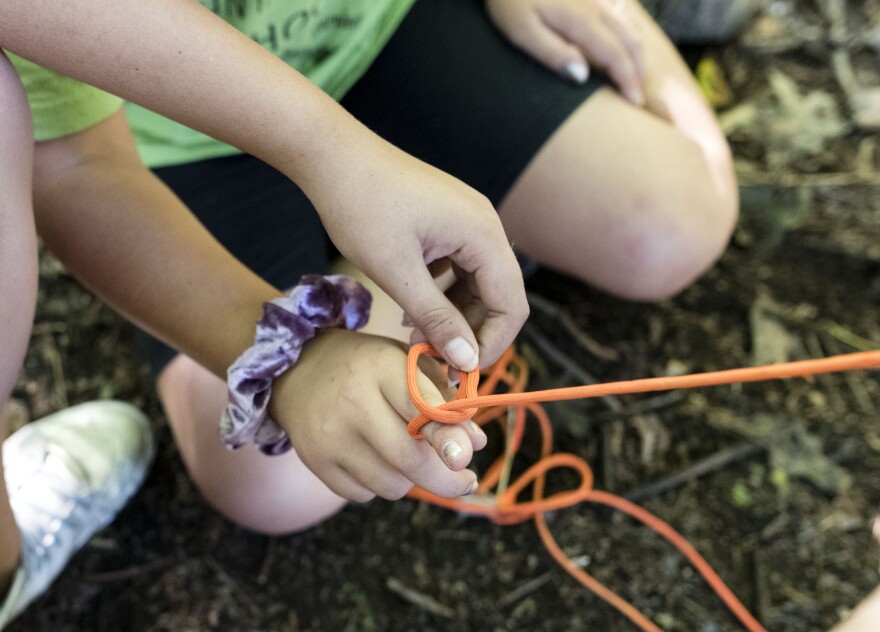
Students in the Mountain SOL program help each other practice knot-tying Sept. 13, 2019, during a class on land the program leases from Morgantown Learning Academy.
Morgantown Learning Academy’s 12-acre campus is well-suited to incorporate outdoor education with its hiking trails, outdoor classroom and garden. Administrative Director Eve Ammons Ward said while the ethos of Mountain SOL is a great fit, it’s not without a few challenges.
“We bring a lot of mud inside,” she said, laughing. Experienced Mountain SOL parents often carry a “survival kit” in their cars, complete with trash bags to more easily deal with muddy kids.
Ammons Ward added that changes in student behavior are immediate and translate inside the classroom. Mountain SOL and MLA expanded their partnership this year to offer a forest-based pre-Kindergarten program called Little Acorns.
“Kids are more focused,” she said. “They’re ready to work, they’re ready to be engaged with their inside part of their education as well.”
Add WVPB as a preferred source on Google to see more from our team
On this West Virginia Week, changes are coming to FEMA, few details on school clothing voucher accusations, and the state has a new guide for data centers.
The facility will use a high pressure, high temperature process known as pyrolysis to break used plastic down into various chemicals including components to create recycled plastic.
In July, U.S. District Judge Gregory Van Tatenhove ordered company associates to pay $18 million in a 2012 lawsuit filed by New London Tobacco Market and Fivemile Energy.
A new report from the U.S. Centers for Disease Control and Prevention (CDC) finds that black lung rates are the highest they’ve been since the 1970s. Justin Hicks and Howard Burkes reported on that for the Appalachia + Mid-South Newsroom. Inside Appalachia’s Mason Adams spoke with Hicks and Burkes to dig a little deeper.