


Preston County Org Recognized For Preservation Of New Deal Project
The recognition is a testament to the work of 40 years to preserve, interpret and educate about the community's history.
Continue Reading Take Me to More NewsAlert (09/10/2026): Our Parkersburg TV transmitter is undergoing maintenance for a few days and will not be operational. We apologize for any inconvenience.
All our programming is available via our TV livestreams on our website and WVPB Passport. Thank you for your patience!




To Educate, Inform, and Inspire by Telling West Virginia's Story

Mountain Readers Week will be held Oct. 5-9, 2026! Celebrate and foster a love of reading in children across West Virginia.

Learn more about Be My Neighbor Day! And check out our recap from last year.

On Demand

On Demand

Stream original productions from WVPB

Watch locally produced documentaries & more.

On Demand

On Demand






West Virginia Morning

Inside Appalachia

West Virginia Week

Mountain Stage

Us & Them

The Legislature Today

The Legislature This Week

Send us your comments and questions.

Stream our board meetings.

Check out the latest WVPB news.

Sign up for our newsletter and get weekly updates.

Meet the WVPB staff.

WV Educational Broadcasting Commission, the WVPB Foundation, and the Friends of WVPB.

Come work with us!

Read our annual report and learn how we educate, inform and inspire with your support.

Sponsor impactful and engaging media and entertainment.

Use your IRA to make a gift to WVPB.

Become a member with your gift of $1,000 or more.

Make WVPB part of your legacy.

Manage your membership account.

Learn how you can Protect and Sustain West Virginia Public Broadcasting.

Craft breweries are popping up all over the region. In West Virginia alone, there are 27 breweries and three quarters of them opened in the last five years.
Sam Fonda, from Weathered Ground Brewery in Raleigh County, West Virginia, has almost 3,000 gallons of soon-to-be-beer fermenting and another 1,000 gallons aging in oak barrels nearby at any given time. That may sound like a lot, but his typical batch is 220 gallons, and that gives him the chance to experiment.
In addition to the basics of water, malted grains, hops and yeast, small craft brewers all over the region are experimenting with locally sourced ingredients to give their beers a unique flavor. Today, you can find West Virginia beers that contain traces of coffee, berries -- even tree branches!

Weathered Ground buys malted grains from the mountains of North Carolina, as well as hops, fruit, and flavorings from local farmers. Working with his neighbors is a source of pride for Sam.
“That’s why using local is so much fun. Because you can have this personal relationship with your suppliers. It’s almost always more expensive. Sometimes double really, but that’s just kind of the price you pay for doing what you want to do. So, we’re happy to pay a little more for the flavor we’re going to, as well as supporting local,” Fonda said.
One of Fonda’s suppliers is JR Ward, a hop farmer and full-time underground coal miner who lives just 20 miles or so down the road in Fairdale. JR loves the farm he has built, with 3,000 square feet of vegetable garden and a quarter acre of hops.
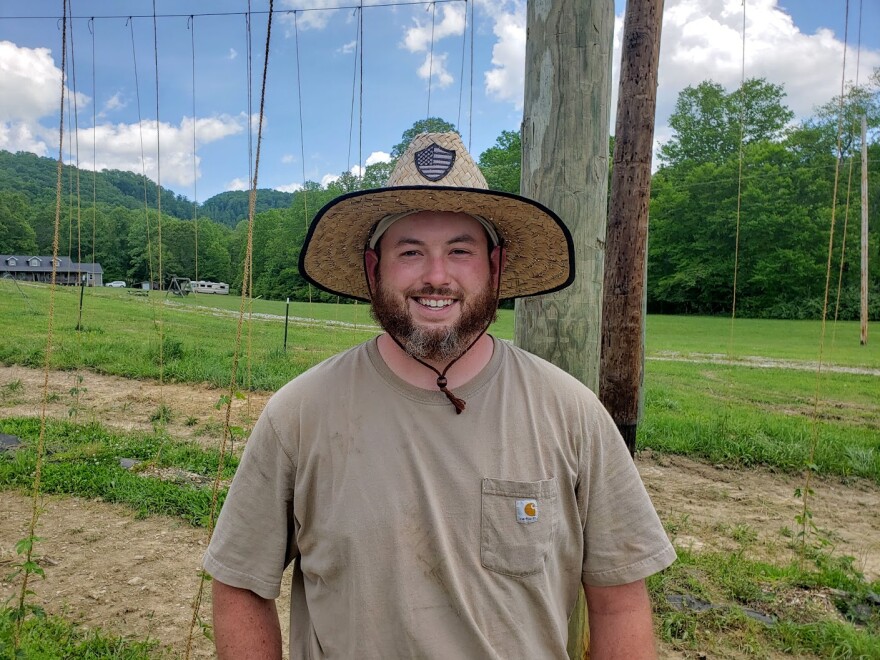
“Years ago, I couldn’t tell you what a hop was, didn’t even know they looked like, did not like craft beer. Then what really made me going forward was a few years ago we had layoffs in the mines and the hard times and I never want to leave here because this is just a piece of heaven to me. And it’s beautiful land, I just started looking into stuff and hops caught my attention,” Ward said.
He currently supplies Weathered Ground with enough hops for 440 gallons of beer in two batches. They are: “Lost Ridge Pale Ale,” named for JR’s farm, and the second is a nod to JR’s other job. It’s called “Hop Farmin’ Miner.”
Starting next year, he plans to expand to five full acres of hop yard on his property and is working with a friend to plant an additional five acres on a nearby farm. That will make Lost Ridge Farms one of the largest hop growers in the state.
Besides hops, Weathered Ground sources local fruits and just about anything that tastes good according to Sam Fonda.
“We brewed an IPA a few weeks ago with birch branches, and then the flavor that comes from birch just unreal, so a lot of people don’t think about that kind of thing when they think about beer, but back in the day, that’s kind of what beer was, what materials do you have on hand,” Fonda said.
There is a growing movement throughout Appalachia for beverage makers to use locally sourced ingredients. It may cost more, but brewers like Sam Fonda believe in the process and so far, they’ve been successful using that business model.
This story is part of an Inside Appalachia episode exploring the alcohol culture and industry in Appalachia.
Add WVPB as a preferred source on Google to see more from our team

With the midterm elections approaching, Us & Them is taking the Dinner Party on the road to a trio of communities across West Virginia. In the first of our three gatherings this fall, host Trey Kay is back in Charleston bringing together conservative and liberal West Virginians to share a potluck meal, talk politics and see whether conversation across the divide can uncover some common ground.
Continue Reading Take Me to More NewsThe recognition is a testament to the work of 40 years to preserve, interpret and educate about the community's history.
Continue Reading Take Me to More NewsIn just over a week, the West Virginia Manufacturers Association will announce the winner of its first ever Coolest Thing Made In West Virginia competition.
Continue Reading Take Me to More NewsThis October, the Adaptive Climbers Festival will gather in Kentucky’s Red River Gorge for the fifth year. In 2023, Folkways Reporter Emily Chen-Newton covered the event for Inside Appalachia. Since then, the Adaptive Climbers Festival has grown. Organizers say they’re nearly at capacity, with 300 climbers, caregivers and volunteers. Ahead of the festival, the campground has made accessibility improvements. Volunteers with the ACF have also been sprucing up the trails.
Continue Reading Take Me to More News