This week, too often, people with mental health challenges or substance use disorder wind up in jail. But crisis response teams offer another way. Also, changes to the Endangered Species Act could benefit big business. They could also kill animals like the eastern hellbender. And, in troubled times, a West Virginia writer says to find peace in nature.
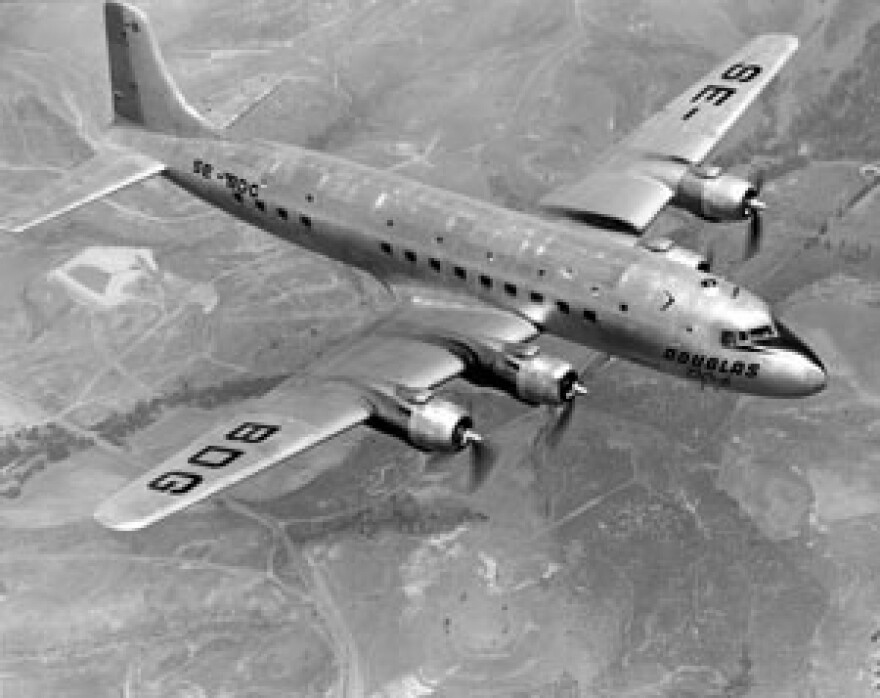
A DC-6 airplane, like this one, crashed after overshooting the runway at Kanawha Airport. The plane was filled with marijuana.
A little after midnight on June 6, 1979, a Douglas DC 6 cargo plane crashed in Charleston, West Virginia while attempting to land at the old Kanawha airport, what is now Yeager Airport.
The plane was carrying approximately 20,000 pounds of marijuana and the crew was made up of drug smugglers from South America. They had never flown into Charleston before, but decided to come to West Virginia believing security would be lighter, according to Stan Bumgardner, a West Virginia historian, and the editor of Goldenseal Magazine.
The plane was too big for the airport at that time and it was overloaded. Unable to stop in time, the plane crashed over the hillside at the end of the runway.
This story from a recent episode of Inside Appalachia includes a slightly different version of the story in the form of a tall tale from storyteller Bil Lepp. His telling is featured on his CD called “Fire Fire! Pants on Liar!” He told this tall tale back in 2008 at the public library in St. Albans, West Virginia.
Lepp is an award-winning storyteller and five-time winner of the West Virginia Liar’s contest. His brother Paul actually wrote the story.
Bumgardner said one of the biggest challenges for the authorities was what to do with the pot after the crash.
Credit Charleston Gazette-Mail file photo
/
Charleston Gazette-Mail file photo
Kanawha County deputies unload bails of marijuana from the pot plane crash.
“With 20,000 pounds of marijuana, it was too much for an evidence room. The feds came in and decided they would burn it,” Bumgardner explained. “The newspaper interviewed Anna Marie Smith and she just talked about how there was an awful smell and it was just burning all the time. And then they asked her about how things had been on the street. And she just said, ‘Well, all of a sudden everybody’s really calm, and they were laughing and talking.’ And it said they started calling her road ‘happy holler.’”
Bumgardner says he’s also heard rumors that seeds from the pot grew up the hillside beside the airport. Authorities tried to kill the plants with diesel fuel, but some locals say the plants didn’t die off and some residents foraged the wild marijuana growing there.
The reason the smugglers were bringing the marijuana into the United States was another issue. Leon Gast was waiting on the ground in a rental truck to collect the goods. The story came out later that he was smuggling the pot to help finance a film about the “Rumble in the Jungle” fight between Muhammad Ali and George Foreman in Zaire in 1974.
Gast was convicted on drug smuggling charges, but once he got out of prison, he did actually make the movie, called “When We Were Kings,” and it won an Academy Award in 1996.
This week, too often, people with mental health challenges or substance use disorder wind up in jail. But crisis response teams offer another way. Also, changes to the Endangered Species Act could benefit big business. They could also kill animals like the eastern hellbender. And, in troubled times, a West Virginia writer says to find peace in nature.
Written by a former slave ship captain, “Amazing Grace” has traveled far beyond its origins. In this encore episode, Us & Them traces how the hymn has become a powerful folk song and civil rights anthem — speaking to pain, forgiveness and the possibility of change.
Appalachia has had high rates of substance abuse and mental health disorders for years. After the problem reached a boiling point during the COVID-19 pandemic, a few communities tried using crisis response teams, and so far, that seems to be working. Last year, Inside Appalachia’s Mason Adams spent several months with some of these teams and has this story.
We explore the history of a song that’s become a universal anthem of hope and forgiveness. “Amazing Grace” was first written as a Christian hymn, and its beginnings in America come in the early 1800s. That’s when people traveled to revivals to worship with preachers from various denominations.